
What Size AC Do I Need for a 2,000 Sq. Ft. House?
.avif)
Depending on how your home is built, a 2.5-ton or 3.5-ton system may make more sense.
Here’s what homeowners should know before choosing the right AC size for a 2,000 sq. ft. house.
Quick Answer: What Size AC for a 2,000 Sq. Ft. House?
For a typical 2,000-square-foot home, 3 tons or approximately 36,000 BTUs is a common starting estimate.
Here’s how the most common sizes compare:
These numbers are only starting points.
If you want to see how AC sizing compares across different home sizes, read our guide on choosing the right AC size for your home.
Is a 2.5-Ton AC Enough for a 2,000 Sq. Ft. House?
It can be.
A 2.5-ton air conditioner provides approximately 30,000 BTUs of cooling capacity per hour.
A 2,000 sq. ft. home may have a lower cooling load if it has features such as:
- Good insulation
- Newer energy-efficient windows
- Good air sealing
- Standard ceiling heights
- Limited afternoon sun exposure
- Well-sealed ductwork
- Plenty of shade around the home
For example, a newer 2,000 sq. ft. home with updated insulation, modern windows, and plenty of shade may require less cooling than an older home of exactly the same size.
That’s why square footage alone shouldn’t determine whether a 2.5-ton system is enough.
Is a 3-Ton AC Right for a 2,000 Sq. Ft. House?
For many homeowners, 3 tons is a reasonable starting point.
A 3-ton air conditioner provides approximately:
36,000 BTUs of cooling capacity per hour.
That capacity can work well for many homes around 2,000 square feet.
However, two 2,000 sq. ft. houses can still have very different cooling needs.
Consider these two homes:
Although both houses have exactly the same square footage, Home B is likely to gain more heat throughout the day.
That difference can affect whether 2.5 tons, 3 tons, or another size is appropriate.
This is why the best way to determine the final system size is through a professional Manual J load calculation.
Could a 2,000 Sq. Ft. House Need a 3.5-Ton AC?
Yes, but a larger system shouldn't be selected simply because it provides more cooling.
A 3.5-ton air conditioner provides approximately 42,000 BTUs of cooling capacity.
A 2,000-square-foot home may have a higher cooling load if it has:
- Large amounts of direct sunlight
- Older or inefficient windows
- High or vaulted ceilings
- Poor insulation
- Significant air leakage
- Multiple stories
- Large open spaces
- Higher-than-average heat gain
Even then, a professional load calculation should determine whether the additional capacity is actually necessary.
Why Bigger Isn't Always Better
It might seem logical that a bigger air conditioner would cool your home better.
But an oversized AC can actually create comfort and efficiency problems.
When an oversized system cools the home too quickly, it may reach the thermostat setting and shut off before completing a normal cooling cycle.
This is known as short cycling.
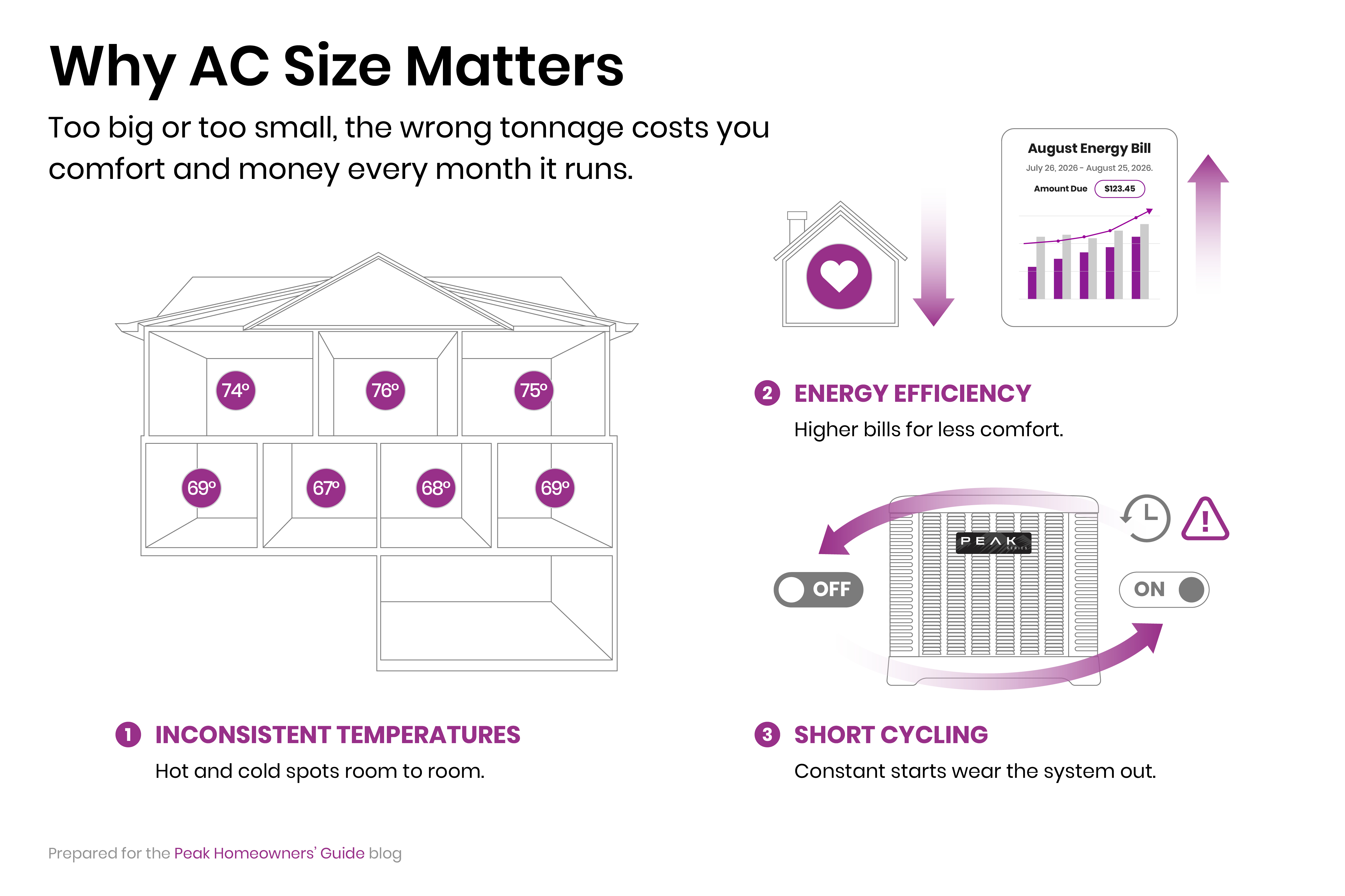
An oversized AC can contribute to:
- Inconsistent temperatures
- Poor humidity control
- Frequent starting and stopping
- Additional system wear
- Unnecessary energy use
An undersized system creates the opposite problem.
It may run almost continuously while struggling to reach your desired indoor temperature, especially during the hottest parts of summer.
The goal isn’t to install the biggest AC possible. It’s to install the system that matches your home's actual cooling needs.
One-Story vs. Two-Story 2,000 Sq. Ft. Homes
A 2,000 sq. ft. home can be built in very different ways.
For example:
- A single-story ranch may have all 2,000 square feet on one level.
- A two-story home may have roughly 1,000 square feet upstairs and 1,000 square feet downstairs.
These homes may behave differently during hot weather.
In two-story homes, the upper level often gets warmer because heat rises and the roof receives direct sunlight throughout the day.
Homeowners may notice:
- Upstairs bedrooms staying warmer
- Different temperatures between floors
- Longer AC run times
- Difficulty balancing airflow upstairs and downstairs
However, that doesn't automatically mean a two-story house needs a larger air conditioner.
The problem could also be related to:
- Duct design
- Airflow
- Insulation
- Return vents
- Attic heat
- System balancing
Increasing AC tonnage without addressing the actual problem could make comfort worse instead of better.
Does a 2,000 Sq. Ft. House With High Ceilings Need a Bigger AC?
Possibly.
Square footage measures floor area, but your air conditioner is actually conditioning a volume of air.
A 2,000 sq. ft. home with standard eight-foot ceilings contains less air than a 2,000 sq. ft. home with 10-, 12-, or vaulted ceilings.
Higher ceilings may therefore increase the home's cooling load.
This is another reason why two homes with the same square footage may need different systems.
What About an Older 2,000 Sq. Ft. Home?
Older homes may have higher cooling requirements than newer homes of the same size.
A 2,000-square-foot house built decades ago may have:
- Older windows
- Less insulation
- More air leakage
- Older ductwork
- Different construction materials
Those characteristics can allow more heat to enter the home.
However, the age of the house alone doesn't determine AC size.
An older home that has received new windows, better insulation, improved ductwork, and air sealing may have a much lower cooling load today than it did when the original HVAC system was installed.
How Manual J Determines the Right AC Size for a 2,000 Sq. Ft. Home
A Manual J load calculation is used to estimate the amount of heating and cooling a specific home requires.
Instead of only asking how many square feet the house has, Manual J considers details such as:
- Conditioned square footage
- Insulation
- Windows and exterior doors
- Ceiling heights
- Home orientation
- Air leakage
- Construction materials
- Local climate
- Occupancy
The calculation provides a better estimate of your home's cooling load.
This is especially useful when you're deciding between closely sized systems, such as a 2.5-ton and 3-ton AC.
For a deeper explanation, read our guide to Manual J and choosing the right HVAC system size for your home.
AC Size and AC Efficiency Aren't the Same Thing
AC size and AC efficiency describe two different things.
AC size tells you how much cooling capacity the system provides.
For example:
- 2.5 tons = 30,000 BTUs
- 3 tons = 36,000 BTUs
- 3.5 tons = 42,000 BTUs
AC efficiency tells you how efficiently the system provides that cooling.
That means two different 3-ton systems can provide approximately the same cooling capacity while having different efficiency ratings.
The first step is determining the capacity your home actually needs. Then you can compare efficiency levels, features, and equipment options within that size.
How Much Does an AC for a 2,000 Sq. Ft. House Cost?
System size is one factor that affects the cost of a new air conditioner, but it isn't the only one.
The final cost can also depend on:
- AC efficiency
- Equipment type
- System features
- Installation complexity
- Electrical requirements
- Ductwork modifications
- Labor
- Your existing HVAC setup
For a more detailed breakdown of current pricing, read our guide to the cost of an air conditioner in 2026.
Paying more for a larger AC does not automatically mean you'll get better cooling or greater comfort.
A properly sized system is more important than simply choosing the highest capacity available.
So, What Size AC Should You Get for a 2,000 Sq. Ft. House?
For many 2,000-square-foot homes, a 3-ton air conditioner with approximately 36,000 BTUs is a common starting point.
However, your actual home could fall closer to 2.5 tons or 3.5 tons depending on its cooling load.
Factors such as your home's insulation, windows, ceiling height, layout, sun exposure, ductwork, and air leakage can all affect the final recommendation.
Rather than choosing an AC based solely on square footage, have your home's actual cooling needs evaluated.
That gives you a much better chance of choosing a system that keeps your home comfortable without installing more—or less—cooling capacity than you need.
FAQ: AC Size for a 2,000 Sq. Ft. House
What size AC do I need for a 2,000 sq. ft. house?
A 3-ton AC, or approximately 36,000 BTUs, is a common starting estimate for a 2,000-square-foot home. However, the final system size should be based on the home's actual cooling load.
How many BTUs do I need for a 2,000 sq. ft. house?
Approximately 36,000 BTUs is a common starting point, although your home's actual requirement may be lower or higher depending on its construction and cooling load.
Is a 2.5-ton AC enough for a 2,000 sq. ft. house?
It can be. A 2.5-ton system may be sufficient for a 2,000 sq. ft. home with good insulation, efficient windows, limited heat gain, and other characteristics that lower the home's cooling requirements.
Is a 3-ton AC enough for 2,000 square feet?
For many homes, yes. A 3-ton air conditioner provides approximately 36,000 BTUs of cooling capacity and is commonly considered for homes around 2,000 square feet.
Is a 3.5-ton AC too big for a 2,000 sq. ft. house?
It may be for some homes, but not necessarily all. Homes with unusually high cooling loads may require additional capacity. A Manual J calculation can determine whether 3.5 tons is appropriate.
Is a 4-ton AC too big for 2,000 square feet?
For many 2,000-square-foot homes, a 4-ton system may provide more cooling capacity than necessary. An oversized AC can contribute to short cycling, humidity problems, and inconsistent comfort.
Does a two-story 2,000 sq. ft. house need a larger AC?
Not automatically. A two-story house may experience warmer temperatures upstairs, but the cause may involve airflow, ductwork, attic heat, or insulation rather than insufficient AC capacity.
Does a 2,000 sq. ft. house with high ceilings need a larger AC?
It may require more cooling capacity because higher ceilings increase the volume of air being conditioned. However, ceiling height is only one part of the overall cooling load.
Should I replace my old AC with the same tonnage?
Not automatically. Your existing system may not have been properly sized, and changes to your home such as new windows, insulation, additions, or air sealing can alter its cooling requirements.
How do I know whether I need a 2.5-ton or 3-ton AC?
The most reliable way to decide is through a professional Manual J load calculation, which evaluates your home's actual cooling needs rather than relying on square footage alone.


